The Reverend Charles Simeon was an Anglican cleric who served as the pastor of Holy Trinity Church, Cambridge, United Kingdom, for over fifty years until his death in 1836. Recently, I listened to a segment on the World Radio podcast, “The Legacy of Charles Simeon” (1), reflecting on Simeon’s life and ministry.
As every pastor does, to some extent or another, Simeon served through difficulty. Difficulty with his congregation and in life. He suffered through poor health but remained faithful. How did he do it? The answer is pretty simple. Biographer Randall Gruendyke said of him, “the thing about Simeon was he believed what he preached.”
This shouldn’t be a shock. After all, shouldn’t this be the case for all of us? That we “believe what we preach.” Perhaps not preaching from the pulpit, but in our lives and action. Gruendyke continued, “one of the things that caused him to exude this sincerity, this deep-seated belief, was the fact that he never got over his conversion.” Inspiring. So simple. Do I need to ask myself, “have I gotten over my conversion?”
This is the issue that Jesus identified as the problem for the Ephesian church in the book of Revelation: “Yet I hold this against you: You have forsaken the love you had at first. Consider how far you have fallen! Repent and do the things you did at first” (Rev 2:4). Have we gotten over our conversion? We probably wouldn’t use such harsh words as we’ve “forsaken the love we had at first.” But, do we, in our day to day lives, see our faith and what Jesus has done for us as kind of old news? Or do we live every day with the recognition of God’s grace in our lives?
Gruendyke said of Simeon, ”because of his conversion, because he came face to face with his sin and its offense before the Lord, but then the even greater sacrifice of Christ on his behalf, he was deeply moved by that.” There are lots of things in life that we should “just get over.” We should move on from and leave behind. But our conversion, the realization of what God has done for us, is not one of them.
I’m convinced that Paul the Apostle was used so greatly by God because he understood the depth of his sin. Paul writes, “Here is a trustworthy saying that deserves full acceptance: Christ Jesus came into the world to save sinners—of whom I am the worst” (1 Tim 1:15). Paul was once an arrogant man, proud of his persecution of believers. But he came face to face with the depth of his sin and, as Gruendyke put it, “the even greater sacrifice of Christ on his behalf.” That changed everything.
Paul, or Charles Simeon for that matter, weren’t the only ones. Every great man or woman of God has lived in the recognition of this understanding: Our sin is great but God’s love is greater. We may not consider ourselves as great men or women of God, but we can live with the same recognition and it will shine through us like a light. As Jesus puts it, “You are the light of the world. A town built on a hill cannot be hidden” (Mat 5:14).
When we consider what John has written, and the pure astonishment and gratitude that come through his words, it is hard not to be moved. He writes, “See what great love the Father has lavished on us, that we should be called children of God! And that is what we are! …” (1 Jon 3:1). Even though our sin is so great, God “lavished” His love on us! Though we were far from Him, He brought us back and calls us “children of God.”
We can’t “get over our conversion.” Not if we reflect each day on the love that God has lavished on us. If we remember each day how God has forgiven us. Our love for God becomes fresh and new. We want to serve Him in new ways. Our “Christianity” does not become a part of our life. Instead, it becomes all of our lives.
There was a day when we first believed. A day when we first understood how much God loved us. We responded with gratitude and decided to change our lives: We repented and turned to God. Do you remember? While our conversion only happens once, each day can be a new, and fresh, recognition of who God is and what He has done for us. That changes how we live, how we work, how we talk, how we think. It changes everything.
Is today that day? Will tomorrow be that day? And the next, and the next? The day that we live in the recognition of God’s unfailing love for us. Never living as though we’ve “gotten over our conversion.”

David Foucar has a passion for teaching God’s word. His first book, “What Do I Say When Asked About Jesus?” is a conversational approach to helping people answer questions about Jesus. The book provides a layman’s perspective on personal evangelism and the basics of the Christian faith. Dave has been married for thirty-six years to the love of his life, Debbie. They have three daughters, two sons-in-law, and two granddaughters. To read more of David’s writing visit his Newsletter.
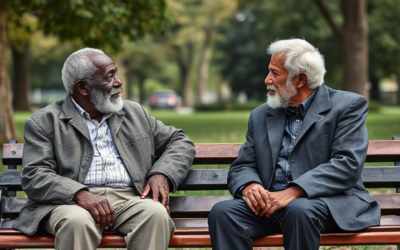
Feature Image Created by Andy Oldham using DeepAi
0 Comments