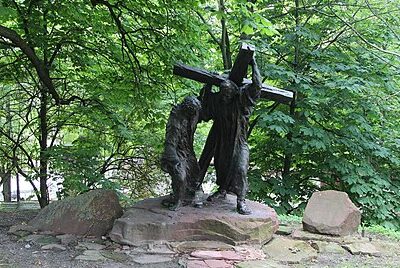

Pressed Into Service
He could never have seen this coming:
“They pressed into service a passer-by coming in the country, Simon of Cyrene (the father of Alexander and Rufus), to bear His cross” (Mark 15:21).
The scene is the events surrounding Jesus’ crucifixion. As Jesus was being led to Golgotha, he was forced to carry the patibulum – the crossbeam of the cross He was to be executed on. Not only did that piece of wood weigh about 100 pounds, but was being carried by a Man who had been brutally beaten, his flesh torn, the blood oozing from His body. He could no longer bear the weight and needed help.
A Roman guard looked around seeking a man fit enough to carry the crossbeam, and found him. Simon successfully accomplished what he was called to do and likely returned to his place among the crowd.
Simon’s role in the crucifixion happened quickly, but what a lasting legacy he left!
Who He Was
Simon was almost assuredly a Jewish man who had traveled to Jerusalem to celebrate the Passover as prescribed in the Mosaic Law (Deuteronomy 16:16). He had come a long way, at least 850 miles – especially in those days of travel by foot or animal – as Cyrene was located in the North African nation of Libya. And Simon was not alone as Cyrene had a large Jewish colony.
As he and his countrymen made their way up to the Holy City, Simon had no way of knowing there had been a trial for a man claiming to be Israel’s Messiah, and that He was sentenced to be crucified. Simon had no clue that his arrival in Jerusalem would coincide with the carrying out of that crucifixion and that he would play a role in it. But play a role he did, and it would impact the rest of his life.
The account is recorded in the Gospels of Matthew and Luke, as well, but there is one slight – but crucial – addition to Mark’s versions, and it says much about the legacy Simon would leave.
The Aftermath
That addition is the mentioning of Simon’s two sons: Alexander and Rufus. Which leads to the question: Why mention these two if at least one of them did not have some kind of significance?
The answer is found in Roman 16, where the Apostle Paul – in closing his great epistle – is giving final instructions. Among them is this, found in verse 13: “Greet Rufus, a choice man in the Lord, also his mother and mine.”
Though this verse does not mention Simon, it does give a clue as to why Rufus was mentioned way back in Mark 15:21. The reason I say “way back” is because the Crucifixion occurred in A.D. 32, and the Book of Romans was written about 25 years later.
Let’s make the connection.
Note in the Romans verse how Paul describes Rufus as “a choice man.” Rufus was recognized in the church at Rome, and known as an exemplary believer in the Lord Jesus. He no doubt loved the Lord and served the early Church faithfully.
And then there is the reference to Rufus’ mother – Simon’s wife or widow – as his “mother and mine [Paul’s].”No, Simon’s wife was not Paul’s actual mother, but had, at some time during Paul’s various travels, showed him maternal care. And Paul never forgot it. He had only high praise for both Rufus and his mother – the son and wife of Simon of Cyrene.
Piecing it Together
Let’s speculate.
Whether or not Simon had ever heard of Jesus before arriving in Jerusalem, he certainly came to. After all, he LITERALLY carried Jesus’ cross. We can assume Simon was deeply impacted by the events of that day and set out to discover just who this Man was.
Having ascertained the facts and placing his faith in His Messiah, Simon resolved to raise his children in the same faith. It is evident that both of them – though Alexander is not mentioned, why otherwise mention him? – shared their father’s faith and grew to be outstanding servants of their King. The same can be said for their mother, who demonstrated her great faith in extending motherly love and care to Paul.
During His ministry, Jesus said, “If anyone wants to come after Me, he must deny himself, take up his cross daily, and follow Me” (Luke 9:23). This command has two meanings: The first is that we follow and obey Christ throughout our lives. The second is that – if called upon – we “follow” Christ in martyrdom.
Simon of Cyrene did at least the first of these, and in so doing raised a family that served the early Church well, helping to spread the Gospel in those crucial days.
He was forced into a task he never could have imagined, successfully fulfilled it, and left a legacy for all believers to emulate: that we pick up our crosses daily and follow the Lord Jesus in whatever way He leads us.
Are you carrying the cross of Jesus?

David Ettinger was born and raised in a Jewish family in New York. After moving to New Mexico as an adult, he suffered through many trials. The nudge of the Holy Spirit caused him to examine his heart and in 1986 he surrendered his life to Jesus and has walked with Him ever since. David holds a BA, and MA, in English from New Mexico State University. He began his journalism career writing for The Roundup, the university paper. After graduation he became the sportswriter for the El Paso Times. He has held many other positions as both writer and editor with major publications. David is active in providing his skills with Zion’s Hope, Inc., in Winter Garden, Florida. His publications include Lifeway publications, Single Parent magazine (Focus on the Family), Zion’s Fire magazine, and Real Life magazine. In addition, he served as managing editor for Zion’s Fire and Real Life. David’s book, Overcomers: 30 Stories of Triumph from the Bible, is available online. David is proud of his son and grandson. Please read his testimony here, on his website.
Featured Image from commons.wikimedia.org

0 Comments