
Memorial Day is here. Maybe the thing that stands out to you is that Memorial Day, here in the U.S., has come to mark the first weekend of summer. Of course, summer actually begins on June 20, with the summer solstice, but since, here in the U.S. at least, many schools have let out for summer vacation, we think of this weekend as the beginning of summer.
Additionally, with Memorial Day comes multiple sales. We see ads and signs everywhere for “Memorial Day Sales.” So, if you’re into shopping and want to save, it might be a good reason to look forward to Memorial Day. Although, for me, and much to my wife’s chagrin, I don’t get too excited about shopping with or without a sale.
We all know, these are not the reasons for Memorial Day, don’t we? But unfortunately, many of us may not think seriously about what Memorial Day really signifies: Self-sacrifice, valor, commitment, love, and, for those who have lost a loved one, grief.
Americans have been celebrating Memorial Day since the end of the Civil War. Hundreds of thousands had lost their lives in that terrible war. Loved ones decorated graves with flowers and wreaths to honor and remember them. The tradition, originally known as Decoration Day, grew with cities all over the country participating. By the turn of the century nearly every state had declared “Decoration Day” an official holiday. Over time, those who died in subsequent wars were included in the remembrances and, in 1971, Congress established Memorial Day as a federal holiday and fixed its observance on the last Monday in May.
Why should we honor those who have lost their lives in war? I hope it is obvious that, especially as Christians, we should have compassion on those grieving the loss of a loved one. Honoring those who have died is a display of compassion for those grieving. Even when not directed individually, doesn’t the remembrance carry with it a sense of compassion for all of those who grieve, now and in the past?
From a national perspective, these men and women have paid the ultimate price for their country. Regardless of our individual political position, shouldn’t every American recognize the greatest of sacrifices? Even when some may doubt the morality of any particular conflict, or the morality of war at all, doesn’t the individual deserve our respect and honor?
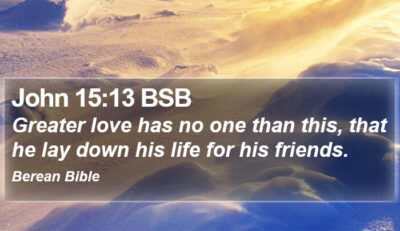
There is something more. Don’t these men and women, I’ll say heroes, epitomize the better qualities we, as humans created by God, even more so as Christians, are called to? Namely: Love for others above self. Jesus said “Greater love has no one than this: to lay down one’s life for one’s friends” (Jon 15:13). And, amazingly, Jesus said this on the very night He was to be arrested, tried, and ultimately crucified on our behalf.
I don’t doubt that many of these men and women had this “greater love” thought in mind when they made the ultimate choice. Perhaps as a believer, I can take a moment and see those who gave so much as an example. Inspired by their sacrifice, am I willing to put others above myself as I am instructed?
Putting others above ourselves is no small task. It is tough. Perhaps tougher than ever in a world that seems to be increasingly centered on self. But Paul teaches, “Do nothing out of selfish ambition or vain conceit. Rather, in humility value others above yourselves, not looking to your own interests but each of you to the interests of the others” (Php 2:3-4).
If we have any doubt about how important thinking of others above ourselves is for the Christian, we just need to look at what Paul says in the prior verses. He says, “…if you have any encouragement from being united with Christ, if any comfort from his love, if any common sharing in the Spirit, if any tenderness and compassion, then make my joy complete by being like-minded, having the same love, being one in spirit and of one mind” (Php 2:1-2)
Did you get that? If we have “any encouragement”, “any comfort”, “any tenderness and compassion” the result should be having a “like-minded” love. This love thinks of others first. Just as Jesus did. This love does not think about me first. Jesus didn’t think of Himself first. This is “greater love.”
Jesus, of course, is our greatest example of love. He has shown us ultimately what love is. We should always look to Him first. But others can be examples as well. Those we’ve known who “walk the walk” and “talk the talk” can encourage us. We don’t worship them but we can look at them and say, with God’s help, if they can do it then I can too.
If we have the right perspective, those we remember on Memorial Day can also be an example to us of “greater love.”
David Foucar has a passion for teaching God’s word. His first book, “What Do I Say When Asked About Jesus?” is a conversational approach to helping people answer questions about Jesus. The book provides a layman’s perspective on personal evangelism and the basics of the Christian faith. Dave has been married for thirty-six years to the love of his life, Debbie. They have three daughters, two sons-in-law, and two granddaughters. To read more of David’s writing visit his Substack page.
Image by Scripture-Images
Greater Love

0 Comments