Text: Joshua 4
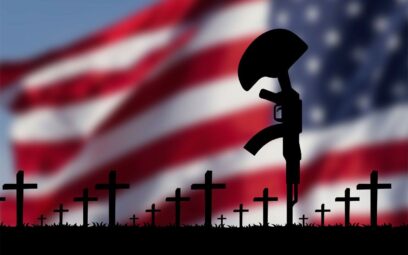
Memorial Day, once known as Decoration Day, is a time-honored federal holiday set aside to remember and honor those men and women who made the ultimate sacrifice while serving in the United States Armed Forces. Its origins trace back to the aftermath of the Civil War, a time when citizens began adorning the graves of fallen soldiers with flowers while lifting up prayers in their memory. Although this practice began in the 1860s, it wasn’t until 1967 that the holiday was officially named “Memorial Day,” and the following year, Congress established its observance on the last Monday of May. This year, it falls on May 26th.
During this time of reflection, one might notice members of the American Legion offering silk poppies outside of grocery stores and community centers. The tradition began in 1920, inspired by the haunting words of the poem “In Flanders Fields,” which referenced the red poppies growing among the graves of fallen soldiers in Belgium. That battlefield, near Flanders, was where 368 American soldiers gave their lives during World War I. These symbolic flowers represent a nation’s tribute to its heroes.
Another profound tradition observed on Memorial Day is the lowering of the American flag to half-mast. This ceremonial act honors over one million military personnel who laid down their lives so that we might live in freedom. It’s a solemn yet powerful reminder that the freedoms we so often take for granted were secured at a great cost.
As we reflect on the meaning of Memorial Day, it is crucial to recognize that it is not merely the beginning of summer or an opportunity for a long weekend. It is a sacred moment set apart for remembrance. And as Christians, this day also invites us to contemplate spiritual memorials—reminders of the ultimate victory won by Jesus Christ, who gave His life to free us from the bondage of sin and death.
So, what comes next after we come to faith in Christ? How do we maintain that passion and sense of purpose? Too often, spiritual defeat follows closely on the heels of great spiritual triumph. But one key to ongoing victory is to build spiritual memorials, just as God instructed the Israelites to do in Joshua 4.
In Joshua 4, after crossing the Jordan River, the Lord instructed the Israelites to set up twelve stones as a memorial to what He had done. Verse 24 gives the purpose: “That all the peoples of the earth may know the hand of the Lord, that it is mighty, that you may fear the Lord your God forever.”
Although many of us may not build physical memorials like those ancient stones, the principle remains: we need to remember. Memorials serve as reminders of people, events, or divine encounters. They testify to what happened and invite others to ask, “What does this mean?”
In Washington, D.C., numerous memorials bear witness to our history:
- The Washington Monument honors our first president and symbolizes our nation’s fight for independence.
- The Lincoln Memorial commemorates Abraham Lincoln and reminds us of the struggle to end slavery.
- The Vietnam Veterans Memorial lists the names of more than 58,000 Americans who died or went missing between 1955 and 1975.
While God may not ask us to construct stone altars, He does ask us to remember. And the word “remember” in the Bible carries great spiritual weight. Psalm 77:11 declares, “I will remember the works of the Lord; surely I will remember Your wonders of old.”
We also call on God to remember us in our time of need. Samson prayed, “O Lord God, remember me, I pray! Strengthen me…” (Judges 16:28). The thief on the cross cried out, “Lord, remember me when You come into Your kingdom” (Luke 23:42).
But perhaps the most remarkable truth is that God remembers us. In Genesis, following the judgment of the flood, we read, “Then God remembered Noah” (Genesis 8:1). God set the rainbow in the sky as a sign of His everlasting covenant not to flood the earth again (Genesis 9:15-16).
When we feel forgotten or burdened by trial, we must remember that God has not forgotten us. He promised, “Never will I leave you; never will I forsake you” (Hebrews 13:5). Jesus assured us, “I am with you always, even to the end of the age” (Matthew 28:20).
Let’s look at three memorials we as believers should establish based on Joshua 4.
- Remember What God Has Done
In Joshua 4:6-7, the Israelites are told to explain the meaning of the stones to future generations: they mark the place where God stopped the Jordan River. These stones are a testimony of God’s power and provision.
You might think, “God hasn’t done anything like that for me.” But God’s miracles are not always parting seas or stopping rivers. Some take time to unfold. Others appear small but are still significant.
Celebrate the small victories. Zechariah 4:10 says, “Do not despise these small beginnings.” I’ve personally witnessed miracles—healings, transformed lives, divine provision. I’ve also walked through hardship. But through it all, God has been faithful. Remembering these moments strengthens our faith.
Psalm 106 warns that when we forget God’s works, our souls become lean—starved and weak. But when we remember, we are fortified.
- Remember God’s Covenant
Joshua 4:19 mentions that the Israelites arrived at Gilgal on the tenth day of the first month—the very day, forty years earlier, that they had been instructed to prepare for the Exodus from Egypt.
The name “Gilgal” means “rolling away.” It was at Gilgal that circumcision was reestablished—a physical sign of God’s covenant with Abraham. Joshua 5:9 says, “Today I have rolled away the reproach of Egypt from you.”
This was a powerful reminder that God keeps His promises. As 1 Chronicles 16:15-17 tells us, God’s covenant with Abraham was everlasting.
But now, through Christ, we live under a new covenant. Jeremiah 31:31-34 prophesied a new agreement: “I will forgive their iniquity, and their sin I will remember no more.” Hebrews 8:6 calls it a better covenant based on better promises.
Jesus instituted this covenant during the Last Supper, saying, “This cup is the new covenant in My blood” (Luke 22:20). Communion is our memorial—a spiritual stone of remembrance.
- Remember That God Is the True God
Joshua 4:24 says, “That all the peoples of the earth may know the hand of the Lord, that it is mighty, that you may fear the Lord your God forever.”
The Israelites were about to enter a land filled with idols and false gods. They needed to remember the Lord who delivered them.
Deuteronomy 6:12-15 warns, “Do not forget the Lord who brought you out of Egypt… Do not follow other gods.”
Today, people worship other “gods” too—money, technology, success. But only the Lord God saves.
I once thanked God for an answered prayer, and the person God used said, “Don’t thank God, thank me!” But we must remember: God may use people, but He alone is the source.
- Remember to Be Loyal to God
Deuteronomy 6:13 says, “Fear the Lord your God, serve Him only.”
Fear here means reverence, awe, and worship. It means loyalty. God says in Isaiah 49:15-16, “I will not forget you. See, I have inscribed you on the palms of My hands.”
Those hands—Jesus’ hands—still bear the marks of the nails. He has inscribed us into His very being.
Knowing this, how can we not be loyal to Him?
Conclusion
On this Memorial Day, as we honor the fallen heroes who secured our freedoms, let us also remember Jesus, who won for us eternal freedom. Let this day not only commemorate the brave but also remind us of the One who gave His life that we might live.
Have you built a memorial in your life to commemorate what God has done? When people look at your life, do they see a testimony?
Peter gives us a call to action in 1 Peter 3:15: “But in your hearts revere Christ as Lord. Always be prepared to give an answer to everyone who asks you to give the reason for the hope that you have.”
Let us remember. Let us testify. Let us never forget.
(Note: This is a condensed version taken from Dennis Lee’s entire sermon, Memorial Day Message: “Our Need to Remember”)

Dennis LeeisSenior Pastor at Living Waters Fellowship,Mesquite, Nevada.He presently has two books,“From Here to There: A Journey to Spiritual Transformation,” and “Wells of Living Waters,”He also writes a religious column for a local newspaper entitled, “Rediscover the Bible for Life,” along with daily devotionals and thoughts that he posts on Facebook, Twitter, LinkedIn, and Living Waters Fellowship’s Website
Image by Wallpaper Cave
I love the point brought out here in how even though it’s important to remember our fallen veterans who gave their lives for our freedom in this country, it is far more important to remember Jesus Christ, Who gave His life for us to free us from the power of sin and death to eternal life with Him to all who place their faith in Him as Lord and Savior. I also love the point brought out here about when people look at our life, do they see a testimony. That is an important question we need to be willing to ask ourselves before God. Are we living out our lives in way that is obvious to others that there is something different about us that is profound? If the answer is yes, then we will be always be prepared to give an answer to the reason for the hope that is in us as stated in 1 Peter 3:15 here. That is what is going to transform the lives of those around us.
Thank you Debbie for your words today. Appreciate.