
I remember years ago watching an old Southern Baptist pastor named Adrian Rogers on Larry King Live, and Larry was pushing Pastor Rogers on his belief that all people needed to accept Jesus to go to heaven. He said, “Pastor Rogers, are you really saying that good Muslims and Jews won’t go to heaven if they don’t accept your Jesus?”
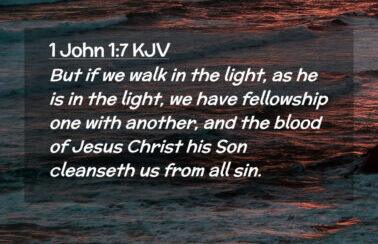
To which Adrian Rogers said, “Larry, I believe my own children won’t go to heaven if they don’t accept Jesus.” All have sinned and come short of the glory of God, and only the blood of a substitute sacrifice can save us.
I know that raises a question for many people, and it goes back to this: “Why Jesus?” People say, “Well, why would a blood payment make any difference to God? It makes God sound like an old Viking warlord.” I once had a Muslim say to me, “What you Christians believe about God makes no sense, saying that God requires a blood sacrifice to forgive us.”
He went on, “If you sinned against me and you asked me for forgiveness, I wouldn’t say, ‘Well, OK, I’ll forgive you, but only if you sacrifice your cat as an atonement for your sin.’”
I said, “Well, first of all, that cat is guiltier of sin and more deserving of death than any of us, but I don’t think that’s the point here. But it’s true—I don’t require a blood sacrifice to offer forgiveness, so why would God? But that’s not thinking about it in the right way: Forgiveness always involves the absorption of a debt.”
A few years ago, my daughter was driving my truck and put a $7,000 dent in it. (It was an impressive dent.) To get insurance to pay for it would ultimately cost me twice that amount. She was absolutely torn up about it, but she also didn’t have $7,000 to fix it. Now, I know some of you will judge me and tell me I should have made her pay it, but in a moment of total fatherly weakness I said, “You know what? I forgive you. Don’t worry about it.”
When I said those words, what happened to the $7,000 worth of damage to my truck? Did it magically go away? I wish. No, the damage was still there. But in saying, “I forgive you,” I had agreed to absorb the cost for her mistake. For the next couple of years, I drove around a dented truck, and then I sold it for less than it would have gotten without the massive dent. I didn’t make her pay for the mistake, which meant that I paid for it. That’s what forgiveness is: absorbing the cost for someone else’s sin.
You say, “I guess that’s true in the case of a mistake with financial ramifications, but a lot of sins don’t have financial ramifications, so the analogy breaks down.” So if you get jealous of me and start slandering me and really hurt my reputation in the eyes of others, it can be hard to see where the “debt” is. But it’s there. Watch this: Let’s say that after you’ve maligned me, but before I launched my counterattack, you came to me and said you were sorry. And I was feeling magnanimous, so I forgave you. In that moment, what has happened? In forgiving you, I’m saying, “I’m not going to punish you or pay you back for what you did. I’m not going to take vengeance on you or seek retaliation; I’m not going to go out and ruin your reputation, and I’m not even going to stay mad at you for the hurt you caused me. I am going to absorb the consequences of your sin.” You can’t see the financial damage, but the damage is just as real. And someone is still paying for it. Forgiveness always involves the absorption of a debt.
The sacrifice of a lamb pictures how God would himself absorb the cost for our sin. But catch this, that only makes sense if God himself is somehow pictured in the lamb—otherwise, killing a lamb in our place is random and cruel.
When Jehovah’s Witnesses or Mormons say to me that Jesus and God are two separate beings, and that God created Jesus, I say, “That makes God cruel, because it means God punished someone random and innocent for my sin. But Jesus and God are not different; they are the same, so salvation is God himself absorbing the penalty for my sin. It’s the ultimate picture of forgiveness. God absorbed the consequences of our sin instead of pouring them out on us.”
This, in many ways, is the whole point of the Bible. God himself absorbed the wrath and penalty for our sin. Our debts, our sins, our mistakes—all beautifully, permanently forgiven.
J.D. Greear is the pastor of The Summit Church, in Raleigh-Durham, North Carolina. He leads the Summit in a bold vision to plant one thousand new churches by the year 2050. Pastor J.D. completed his Ph.D. in Theology at Southeastern Baptist Theological Seminary. He has served as a member of the Board of Directors of Chick-fil-A since January 2022 and recently served as the 62nd president of the Southern Baptist Convention. Pastor J.D. and his wife Veronica are raising four awesome kids: Kharis, Alethia, Ryah, and Adon.This article has been republished with permission from the J.D. Greear website and is under copyright law. It may not be republished without express written consent by J.D. Greear Ministries Team. J.D. Greear is the author of 27 Books including his newest book, Everyday Revolutionary: How to Trancend the Culture War and Transform the World.
Image by Scripture-Images
Books by J.D. Greear
 In Everyday Revolutionary, pastor J.D. Greear calls us to reimagine our Christian witness in today’s world. Written for those of us who feel like outsiders in this new era, Everyday Revolutionary draws on the story of Daniel to help us “live sent” right where we are. This Christian guide to “living quietly but testifying loudly”
0 Comments