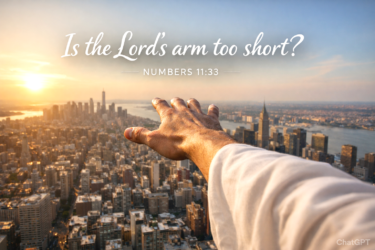

“The Lord will lay bare his holy arm in the sight of all the nations, and all the ends of the earth will see the salvation of our God” (Isa. 52:10).
In 2025, I chose to read through the New Testament. I finished in mid-October, so I had some time to read a bit of the Old Testament. I read Proverbs and Isaiah. These were good choices. In Isaiah, I was looking for evidences of God’s grace in the midst of prophetic judgement against sin. I was also looking for Messianic passages like Isaiah 53 and allusions to the New Covenant.
What I did not expect to find was numerous references to God’s arm. This joyful discovery aligned quite well with a series of articles I wrote on my blog two years ago on the biblical imagery in Ezra and Nehemiah, where I reflected on God’s hands, mouth, eyes, and ears.
I invite you to join me as I unpack this human body part God singled out in Isaiah to highlight His powerful presence among His people in three ways: His arm enabled His gracious hand to reach out to protect and provide for them, bring them salvation, and demonstrate His strength.
First, let us look at the biblical context of the usage of this word.
God’s arm connects His heart to His hand
This imagery of God’s arm in Isaiah, as well as other parts of the human body that Scripture sometimes uses as a figure of speech to describe various aspects of God’s eternal character is called personification. It is a fairly commonly used literary device that more clearly reveals who God is so that we can relate properly to Him. The arm of God is a simple illustration that men and women of all cultures, times, and places can easily grasp. Let us consider what the arm does.
The arm connects the trunk of the body to the hand. It extends the hand so that it can do what it does best. As I was reading these verses in Isaiah, I imagined God’s long arm reaching out to His chosen people so that His gracious hand can provide, protect, and discipline when necessary. I saw the arm of God providing a direct connection between God’s heart, where figuratively speaking His love would reside, and His hand which brought rescue where it was needed.
In The International Standard Bible Encyclopedia, we read, “In the vast majority of usages, this word denotes the awesome might of Yahweh. . . With ‘an outstretched arm’ He had delivered His people from bondage. . . Israel knew that her national life rested upon ‘the everlasting arms’ of her God (Dt. 33:27).”
God’s arm brings deliverance
Have you ever felt God was too far away to reach out and rescue you from trouble?
In Isa. 50:2, we read the first of a two-part rhetorical question that God asked: “Was my arm too short to deliver you?” The obvious answer is a resounding, “No!” God’s arm is long enough.
There is a cross-reference to Num. 11:23 in the margin of my study Bible next to this verse that reinforced my comprehension of this image. In the desert, when Moses was asking Yahweh to provide some meat in addition to the manna, God asks rhetorically, “Is the Lord’s arm too short?” This response implied that He is within reach and that we are never too far from God.
Later, in Isa 52:10, we hear, ““The Lord will lay bare his holy arm in the sight of all the nations, and all the ends of the earth will see the salvation of our God.” I can see His veins poking out.
In a prophetic passage that Jesus later fulfills as the Lamb of God who takes away the sins of the world, God asks another rhetorical question which gets answered in the rest of chapter 53. In verse 1, He queries, “Who has believed our message and to whom has the arm of the Lord been revealed?” The who is the nation of Israel. God’s arm of salvation was demonstrated to His chosen people over and over again as He led them in the desert and provided their needs.
God’s arm represents His strength
Have you ever felt God needed to show up in a powerful way to meet your needs?
The second part of God’s question in Isa. 50:2 was, “Do I lack the strength to rescue you?” He is emphasizing two aspects of His character: 1) His willingness to reach out to His people in need, and 2) His divine strength to accomplish whatever is needed. God’s arm is strong enough.
This may be a good example of Hebrew parallelism. His arm corresponds with His strength. The word “deliver” corresponds with “rescue.” In a diagram, these two lines might look this way:
Was my arm (A) too short to deliver (B) you?
Do I lack the strength (A’) to rescue (B’) you?
As we read on, we see more verses that remind us He will show Himself strong.
In Isa. 51:5, Yahweh declared, “My arm will bring justice to the nations. The islands will look to me and wait in hope for my arm.” Whenever you see the word “nations,” it is referring to people outside of Israel who in the last days would also experience God’s deliverance and salvation. We should be excited, because this prophecy is about us and the hope that we have in Him now.
Lastly, I was amazed to see that God shared His strength with His coworker whom He had called to deliver the Israelites from Egypt. The prophet Isaiah recounts the story of Moses at the Red Sea, where God “sent his glorious arm of power to be at Moses’s right hand, who divided the waters before them” (Isa. 63:12). I loved the well-crafted divine word play and the irony when I read that God’s arm transferred His strength directly to Moses’ obedient hand as he parted the Red Sea.
How does this affect my daily walk?
We have just taken a deep dive into theology proper as we’ve focused on the immanent attributes of God the Father (meaning His qualities that impact us right here on earth and not just far away in heaven). This discussion is also practical. Learning who God is always affects how we live.
I have seen God’s arm in action. Knowing that God is never far away and will always be willing to reach out in His grace and mercy to provide in my time of need allows me to experience the “peace that passes all understanding.” (See Phil. 4:7.) Knowing that He is strong enough to deliver me either through or out of the suffering I experience has always helped me to press on.
The biggest daily impact of knowing who God is that I have seen is in my prayer life. As Heb. 4:16 exhorts believers who know that their sins are forgiven in Christ and that He is our High Priest, we can boldly “approach God’s throne of grace with confidence, so that we may receive mercy and find grace to help us in our time of need. I have done this my entire Christian life.
Closing thoughts
There are two things I want my readers to take away.
The first is that the God who revealed Himself to the Israelites as their creator whom they could trust, whose arms were long enough to reach out in mercy and grace wherever they needed Him and were strong enough to be able to deliver them through every trial can be known by us now.
The second is this. God has no literal arms, but the Son of God does. Knowing Jesus Christ is the only way to have a relationship with the God of the Bible whose arm has been described above. God reached out in love, not only to the Israelites but to the whole world by sending His one and only Son. Whoever believes in Him has eternal life (John 3:16). Jesus clearly stated, “I am the way and the truth and the life. No one comes to the Father except through me” (John 14:6).
I trust that you will take note of those times in the past where God has reached out to you in Him mercy and grace. If you are in need of His deliverance and strength now and in the future, He will always be there.
Russell E. Gehrlein (Master Sergeant, U.S. Army, Retired) is a Christian, husband, grandfather, blogger, and author of Immanuel Labor – God’s Presence in our Profession. With degrees in mathematics and biblical studies, his career spans teaching, youth ministry, military service, and civilian work at Fort Leonard Wood. He writes to help others experience God’s presence and integrate faith at work. His articles appear in military journals and faith-based platforms including The Gospel Coalition, Made to Flourish, and the Center for Faith & Work.
Image by ChatGPT
Books by Russell Gehrlein
 Here is a clear, biblical introduction to the Christian view of work. It is designed to help believers seek God’s guidance in choosing a vocation and integrating their faith with everyday jobs. Rooted in Scripture, it combines practical wisdom, personal illustrations, and insights from Christian leaders. Topics include the value of ordinary work, the effects of the Fall, the eternal significance of labor, finding a good fit, how Christians should work, and implications for ministry. With extensive Scripture references and discussion questions, this book broadens your understanding of how God uses your gifts at work and how His presence transforms it.
0 Comments