

A 20-something friend from church recently approached me, concerned about her grandmother. The 82-year-old woman, once a vibrant Christian role model for her granddaughter, had gotten in the habit of watching news for hours every day. She harshly condemned anyone who differed from her political beliefs, including her own granddaughter.
The granddaughter also felt frustrated because whenever she visited, her grandmother constantly checked her phone, scrolling through Facebook feeds while the granddaughter tried to talk with her. The granddaughter lamented the loss of close connection she once felt with her grandmother.
A Question for Our Own Hearts
How desperately we aging Baby Boomers need to hear the granddaughter’s heart cry. May we search our hearts and ask the Holy Spirit to show us what consumes us. Are we living as citizens of heaven who recognize, as my 100-year-old missionary friend puts it, “The next big step is glory!”? (See Philippians 3:20.)
Or are we consumed with “earthly things” — 24-hour news, political pundits, social media scrolling, and our own deeply held beliefs that have little to do with life as a heavenly citizen? Or are we so busy with leisure activities whose siren song calls to older adults that we have no time to listen to our younger friends and offer the wisdom we’ve gained over years of walking with Christ?
“Finishing Our Course with Joy”
While our joy-filled God certainly invites us to rest and play, to care for our bodies in our twilight years, he also enlists us in a lifelong calling to join Christ in anticipating the day the heavenly kingdom will be brought to earth.
How then should we live as dual citizens of heaven and earth, how do we “finish our course with joy,” as theologian J. I. Packer wrote?
Living as Citizens of Heaven
Let’s turn to Colossians 3, which describes the life of women and men mature in Christlike character. Such older adults recognize the reality that they are “holy” (set apart), “chosen” (adopted by God the Father into his family), and beloved (cherished by the triune God.) In this reality, we live as citizens of heaven now—not perfectly, but visibly, and compellingly.
“Put on then…compassionate hearts, kindness” (Colossians 3:12).
Compassion is what Jesus felt when he saw people as “harassed and helpless, like sheep without a shepherd” (Matt. 9:36). Kindness is “goodness in action.”
Compassionate hearts look for the harassed and helpless, the young woman with rings emerging from every orifice, the middle-aged man burnt out on work, and in looking, see the longing to know that they are holy, chosen, and beloved. Such hearts move toward hurting people with goodness, writing letters or texts, inviting for coffee, asking questions, and truly listening to the answers.
“Put on then…humility, meekness, and patience” (Colossians 3:12).
We live with the humility and sacrificial love that sent Christ to this earth to take on human flesh and to die the most humiliating death — death on a cross (See Philippians 2:5-11). Such humility resists launching into long, puffy monologues about our beliefs (even our Christian ones, but especially our political ones!).
Meekness is the very quality Christ names in himself when he invites the harassed and helpless to come to him and find rest for their souls: “I am gentle (from the same Greek root as “meek,”) and lowly, and you will find rest for your souls” (Matt. 11:28-31).
This triumvirate of Christlike graces—humility, meekness, and patience—waits for others to grow and learn and gently draws them toward the only knowledge that matters — the knowledge of Christ, displayed through our humble, meek, and patient manner.
When we dress ourselves in such royal robes, we live as the lovely emissaries of God’s grace, ambassadors inviting others to know the joy of his heavenly kingdom.
As we look at Colossians 3:13-17, we see how grace flows in three areas of our lives: grace flowing out in our relationships, grace filling us with inner peace and wisdom, and grace overflowing in worship and gratitude. Let’s look at each of these.
Grace Flowing Out in Our Relationships
As we will see from the “-ing” participle endings, each of the actions described here is ongoing—habits of grace in motion.
Bearing with one another and forgiving those who have harmed us (Colossians 3:13).
We endure others’ thoughtlessness, and instead of “grumbling and disputing” (Philippians 2:14) when family members forget to call or text, we reach out to them, recognizing how full their lives are.
We examine our relationships, looking to forgive harm, not excusing it or minimizing it, but forgiving as “God in Christ forgave [us]” (Ephesians 4:32).
Putting on love, which binds everything together in perfect harmony” (Colossians 3:14).
Such love looks at differences and sees the beauty of how God has bound together a diverse people, people with different hair, skin, and eye colors, different political beliefs, and different gifts and passions. Such love sees that we will worship and enjoy God for eternity with people we might never have chosen to dine with on this earth.
Grace-filled, harmonious relationships are our future in heaven. As citizens of heaven, in the power of the Holy Spirit, we begin to live these relationships now.
Grace Filling Us with Inner Peace and Wisdom
Not only does grace shape our relationships; it steadies our souls with peace and wisdom.
“Letting the peace of Christ rule in your hearts” (Colossians 3:15).
Rather than letting the news cycle alarm and frighten us, we turn to Christ, the King of Peace, and rest in his wise rule. Rather than being shaken by dire diagnoses, we trust that Christ rules every cell of our bodies.
“Letting the word of Christ dwell in you richly, teaching and admonishing one another with all wisdom…” (Colossians 3:16).
We spend far more time scrolling through Scripture than we do on social media; we turn to Scripture as our constitution which not only tells us how to live as citizens of heaven but actually transforms us, giving us the power to do so (See Hebrews 4:12). As our hearts are transformed, we gain the wisdom—marked by humility, meekness, and patience—to “teach” and “admonish” one another in ways that truly encourage those coming behind us.
Grace Overflowing in Worship and Gratitude
“Singing psalms and hymns and spiritual songs” (Colossians 3:16).
We sing, yes, even in shaky voices, in worship that both anticipates life in the new heavens and new earth and encourages our sisters and brothers right now.
“Be thankful…” “with thankfulness in our hearts to God…” “giving thanks to God….” (Colossians 3:15, 16, 17).
There’s a reason Paul repeats the call to gratitude three times . While studies show that gratitude benefits older adults, Scripture reveals something deeper: gratitude is the only natural response to God’s grace working in our lives.
“Do everything in the name of the Lord Jesus, (giving thanks to God the Father through him” (Colossians 3:17).
We do everything, all things with the purpose of glorifying and enjoying God. Whether going in for surgery or going to visit grandchildren; whether writing letters to prisoners or sending a note to encourage a young mom, we recognize that every numbered minute, hour, day, month, and year is an opportunity to live in gratitude for the glory of God.
How Then Shall We Live?
Just think of my dear young friend, of her longing to enjoy time with her grandmother, her desire to glean from her wisdom in what might be her last year or last decade of her life.
As we enter our 60’s, 70’s, 80’s, 90’s, or even 100’s, we live with the intense hope and longing for the day we will meet Jesus face to face. At the same time, we recognize that our days on earth to live as ambassadors of God’s grace, to pass on the hope-filled legacy of good news about Jesus Christ, are numbered.
So let us live these days as God’s chosen, holy, and beloved, overflowing with his grace in others’ lives. And when God takes us on the next big step to glory, may those who knew us say that we lived as citizens of heaven long before we arrived.
As always, I’d love to hear from you! How have you seen older adults live as citizens of heaven? (Or, what makes living in this way hard?)
Dr. Elizabeth Reynolds Turnage is a gospel life and legacy coach, author, and speaker. She helps people live, prepare, and share their legacy to bring hope to future generations. Elizabeth co-founded the Numbering Your Days Network to share gospel encouragement for aging, caregiving, legacy, grief, and end-of-life and wrote Preparing for Glory: Biblical Answers to 40 Questions about Living and Dying in the Hope of Heaven. Elizabeth and her husband Kip enjoy feasting and sharing good stories with their large family of four adult children, four children-in-law, and six young grandchildren. Learn more at www.elizabethturnage.com
Image by ChatGPT
Books by Dr. Elizabeth Reynolds Turnage:

Whether you are thecaregiver or the patient, the “what-if’s” of the waiting room can feel terrifying, and the wait can feel agonizing. Cancer, tumor, stroke, traumatic injury, or major surgery—a health crisis of any kind involves waiting. This waiting arouses many emotions: fear, uncertainty, sorrow, agony, and anger among them. In this devotional for caregivers and patients, Elizabeth Reynolds Turnage reminds us of the certain hope and surpassing peace of the gospel: God has worked miraculous deeds and redemptive wonders in the past, and Jesus will “soon” come again to end our wait, and to bring full and final healing. These sixty meditations for peace and hope will encourage you as you wait.
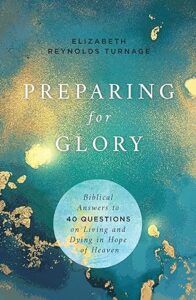
Will I become an angel when I die? What is life like in heaven? How do I leave a spiritual legacy?
You don’t have to be dying to have questions about death, the afterlife, legacy planning, and more. Life and legacy coach Elizabeth Turnage presents bite-size biblical answers on theological and practical issues, accompanied by beautiful hymns, prayers, reflection questions, and additional resources. Rediscover hope as you meditate on the glory that lies ahead.
0 Comments