

What if our first question in every situation—every opportunity, every blessing, every difficulty, every obstacle, was this: “God, how am I supposed to use this to glorify you and point people to your gospel?”
When Hebrews 11 says that “all these … did not receive what was promised, since … apart from us they should not be made perfect” (vv. 39–40 ESV), it’s not just saying that “the ones whom God let suffer didn’t receive the promise.” That’s true. But that’s not all of it. None of the people in Hebrews received the full promise. Even the winners in the list. All of them died incomplete.
At first, this can be a little confusing, since some of these people really did seem to receive “the promise.” I mean, Noah got delivered through the ark; Daniel slept through the lion’s den; Abraham got the Promised Land; David knocked down Goliath. Clearly “the promise” in view here was not a promise of temporary relief from pain or a temporary manifestation of power. It has to mean something more. But what?
The life of Jesus provides a hint. Have you ever stopped to think that all of Jesus’ healing miracles on earth were temporary? Lazarus, for instance, was raised from the dead—but there came a point where Lazarus died a second time and was buried a second time. It was probably even in the same grave! Every person Jesus raised from the dead died again. Every blind eye Jesus opened went blind again—because when we die, we’re all blind. Jesus performed incredible miracles, but every person he healed ended up in the grave.
In the same way, all the miracles recorded in Hebrews 11 were, from heaven’s perspective, just temporary. The point was never a temporary miracle. No, all these temporary manifestations of power served a greater purpose—highlighting that God was coming to earth to take the penalty of sin and the curse of death into himself so that we could be saved. God’s purpose has always been to show the world that.
And that’s what the writer means by “apart from us, they should not be made perfect.” “Made perfect” means “made complete.” Somehow, J.D. Greear’s life of faith makes Abraham’s faith complete? That’s a staggering claim. How does it work?
It’s not that my faith is stronger or better than Abraham’s. It’s that I’m completing the purpose for which God has us show faith in the world—to show that he is bigger and that he is better. Until his gospel is understood and believed throughout the world, that purpose is still incomplete. So apart from our efforts, the work of these great heroes is left incomplete.
When we understand that as God’s primary purpose in the world, it changes everything. The point of faith is not to make your life easier; it’s pointing people to the power and worth of God revealed in the gospel. That means however God answers my prayer, in whatever role he calls me to play, my goal is to leverage that to display his power and worth. Whether in prosperity or poverty, popularity or shame, sickness or health, rewarding relationships or dysfunctional ones, my primary question is: How can I use this to glorify God? How can I use this to point people to the gospel?
J.D. Greear is the pastor of The Summit Church, in Raleigh-Durham, North Carolina. He leads the Summit in a bold vision to plant one thousand new churches by the year 2050. Pastor J.D. completed his Ph.D. in Theology at Southeastern Baptist Theological Seminary. He has served as a member of the Board of Directors of Chick-fil-A since January 2022 and recently served as the 62nd president of the Southern Baptist Convention. Pastor J.D. and his wife Veronica are raising four awesome kids: Kharis, Alethia, Ryah, and Adon.
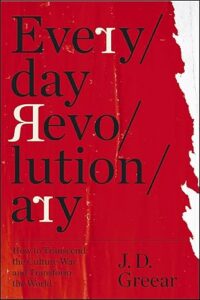
This article has been republished from the J.D. Greear website and is under copyright law. It may not be republished without express writThis articleten consent by J.D. Greear Ministries Team. J.D. Greear is the author of 27 Books including his newest book, Everyday Revolutionary: How to Trancend the Culture War and Transform the World.
Image by Copilot
Books by J.D. Greear




0 Comments