
Have you ever felt like following God made life harder, not easier? Moses feels your pain. So did his son Gershom—literally.
Shortly after God called Moses to rescue his people from slavery, Moses took his wife, Zipporah, and his sons, Gershom and Eliezer, to make the trek to Egypt. I imagine Moses had plenty on his mind already. He was about to confront the most powerful man in the world, armed only with a stick and a promise. And he wasn’t particularly confident in either. But as they made their journey, things got, well, a little weird:
At a lodging place on the way the Lord met him and sought to put him to death. Then Zipporah took a flint and cut off her son’s foreskin and touched Moses’ feet with it and said, “Surely you are a bridegroom of blood to me!” So he let him alone. It was then that she said, “A bridegroom of blood,” because of the circumcision. (Exodus 4:24–26 ESV)
And all God’s people said …What??
You’re like, “I didn’t know the word ‘foreskin’ was even in the Bible. And why is Zipporah touching Moses with it? This whole thing just grosses me out.” Fair enough.
As we taught through Exodus last year, I considered skipping this little vignette. Most of the Bible teachers I consult skip it. And you can imagine why. It’s not just uncomfortable; it’s also really confusing. But I didn’t want to deal with all the accusations that I’m a wimpy pastor who skips all the hard stuff in the Bible. Plus, this little scene illustrates something we see earlier in Exodus—something I had never seen until I studied it last year.
I’ve heard certain scholars say that the book of Exodus establishes the melody line of salvation, a melody played over and over again throughout the rest of the Old Testament, and then the rest of the Bible. The primary melody line happens in the heart of the book, when God rescues his people from Egypt and leads them through the sea. But there are previews of that salvation before and echoes of that salvation after. Just like in an orchestral piece, the melody line appears several times, but not usually in an identical way. The music is familiar and recognizable, but it adapts as the song progresses.
That happens here too. In this story, we hear a preview of the more robust melody line of salvation to come. And it begins by recognizing that Moses, even though he had started to follow God, had failed to obey the Lord’s instructions about circumcision.
You see, in Genesis 17, God had established circumcision as the sign of his covenant with Abraham, and he commanded every male descendant of Abraham from that day forward to be circumcised on the eighth day after birth. It was serious: God had said, “Any uncircumcised male … shall be cut off from his people; he has broken my covenant” (Genesis 17:14).
Up until this moment in Moses’ life, he hadn’t really been obeying God, but that all changed at the burning bush. God had given him space to obey him about circumcision, and Moses had ignored him. In case you haven’t noticed, obedience is a really big deal to God, so God is coming, literally, to destroy Moses. In an ironic twist, Moses isn’t the one who recognizes what’s going on. It’s Zipporah, his non-Israelite wife, who steps in. She obeys the circumcision command in Moses’ place, then touches Moses’ feet with the bloody foreskin.
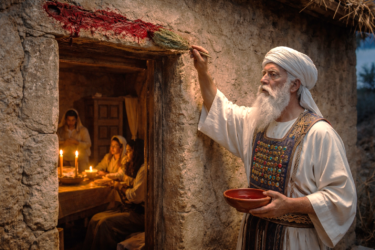
All of this is a prelude to the melody line we’ll hear repeated again in the actual Passover. As the Israelites leave Egypt to follow God, they have to smear the blood of a sacrificed lamb on the doorpost of the houses so that the death angel—who was coming to strike Egypt’s firstborn sons—won’t come into their houses and strike their firstborns, because Israel was guilty of the same sins as the Egyptians. Only by putting the blood of a sacrificed lamb on the doorposts of their houses could they be saved.
Interestingly, the word “touched” used in Exodus 4:25 is the same word used in Exodus 12 for how they applied the blood on the doorposts during the Passover. It says they “touched” the doorposts with the blood of the lamb. The author is drawing a direct parallel between these two events, trying to get you to imagine the upcoming Passover even in this small circumcision scene on the side of the road.
Do you see the throughline? Can you hear the melody? God’s people try to obey and they can’t, so someone intercedes for them with a blood offering. Zipporah offered that blood in Exodus 4. The lambs provided the blood in Exodus 12. And ultimately, centuries later, Jesus himself would offer that blood for you and me, touching our hearts so that we could live.
Jesus is the truer and better Zipporah, interceding on our behalf, obeying for us, even shedding his own blood—all so we could escape the curse of sin and death.
J.D. Greear is the pastor of The Summit Church, in Raleigh-Durham, North Carolina. He leads the Summit in a bold vision to plant one thousand new churches by the year 2050. Pastor J.D. completed his Ph.D. in Theology at Southeastern Baptist Theological Seminary. He has served as a member of the Board of Directors of Chick-fil-A since January 2022 and recently served as the 62nd president of the Southern Baptist Convention. Pastor J.D. and his wife Veronica are raising four awesome kids: Kharis, Alethia, Ryah, and Adon.This article has been republished with permission from the J.D. Greear website and is under copyright law. It may not be republished without express written consent by J.D. Greear Ministries Team. J.D. Greear is the author of 27 Books including his newest book, Everyday Revolutionary: How to Trancend the Culture War and Transform the World.
Image by ChatGPT
Books by J.D. Greear
 In Everyday Revolutionary, pastor J.D. Greear calls us to reimagine our Christian witness in today’s world. Written for those of us who feel like outsiders in this new era, Everyday Revolutionary draws on the story of Daniel to help us “live sent” right where we are. This Christian guide to “living quietly but testifying loudly”




0 Comments