
from there the Lord your God will gather you and bring you back.
Deuteronomy 30:4 (NIV)
As a parent, I always expected that somehow, in some way, my daughters would rebel. I hoped that I was wrong, but I’ve observed the human condition for too long to harbor any pipe dreams. As I contemplated the eventuality of their wandering — whatever that might look like — I came to a realization.
When it comes to what my young adult children do, the only thing I really control is my response.
I figured that I’d better give that some thought ahead of time. I’m glad I did. Yes, both girls had their season of wandering each in their own way, but those are their stories to tell. What I learned along the way was that my best example for parenting was Father God.
Deuteronomy has had some really tough chapters to slog through. It contains some of the most difficult and challenging of the ancient texts. But today’s chapter stands like a breath of fresh air because it gets at the heart of who God is and what God is all about. In short, God tells His Hebrew children that He knows they’re going wander. It’s not a matter of “if” but “when.” In light of this, He wants them to know teshuvah.
Teshuvah is a Hebrew word we translate into English as “return,” but like many Hebrew words one simple English word cannot contain its meaning.
Teshuvah is “return” as in go back where you belong.
It assumes something breathtaking:
You had a place.
You wandered.
That place still exists.
You are still wanted there.
Teshuvah has a rhythm.
First, there is an awakening. Something stirs. There’s discomfort. “Wait a minute. This isn’t who I want to be.” Clarity – not condemnation.
Next comes the turning. It’s not just a change in thought, it’s physical. You’ve reached second base and are as far from home as possible. You’re facing the centerfield fence. You physically make the turn toward third and the path home is right there waiting.
Then there’s naming. This isn’t a wallow in shame, but the moment of truth telling. It’s the first step of the Twelve Steps. “My life has gotten out of control. This isn’t manageable.”
The way is now open to repairing. Own it. Apologize. Make things right. You carry responsibility without drowning in it.
With that, you return home.
Today’s chapter lays out the theology of teshuvah. Jesus turned it into a love story we know as the Prodigal Son. As a young parent reflecting on how I should respond when my daughters wander, I took note of three things about the Prodigal’s father (aka Father God).
- He didn’t go to the distant land to condemn his son and drag him home.
- He was sitting on the front porch, eyes on the road, waiting for his son.
- He ran down the road to greet his son, and escort him home.
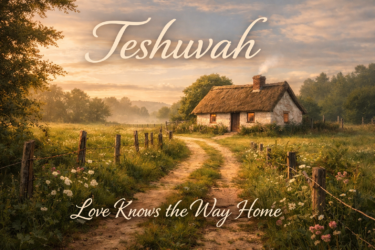
Not a bad example to follow, I thought to myself. Trust teshuvah. Love knows the way home. If I’m wise, I’ll even keep my mouth shut. Directions aren’t necessary.
One of our daughters lived in a commune for a season with a very diverse community of individuals from all over the globe. One day she shared with me that as her comrades shared their stories most of them had no home, no support system, and they lived perpetually on the brink of hopelessness.
They had no where else to go.
“I realized,” my daughter said, “that I will never know that reality. I always have a home I can return to where I am loved and will be cared for.”
Bingo. That’s what Father God wants His children to know with all their heart and soul.
Teshuvah.
Shalom.
Tom Vander Well believes the universe is a work of God’s artistry— embellished by Van Gough’s brush, Miles Davis’s trumpet, and Bob Dylan’s lyrics. He believes in hot coffee, and quiet conversations with God before dawn. He believes that life is an eternal journey with those we love. He also believes grace is costly and salvation is free. Tom and his wife Wendy live in Iowa. He is an amateur actor, playwright, and teacher among his local Jesus followers. You may find out more about Tom at Wayfarer.
Image by ChatGPT




0 Comments