
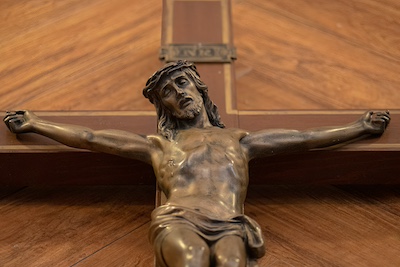
The 7 Statements of Jesus from the Cross: Statement 2
“Truly, I say to you, today you will be with me in paradise.”
So, we’re working our way through the Gospel of John and we’ve come to the place where Jesus is in the very process of dying on the cross, even as he said he would be. Long before he was lifted up on the cross, Jesus said prophetically, “And as Moses lifted up the serpent in the wilderness, so must the Son of Man be lifted up, that whoever believes in him may have eternal life.” (John 3:14-15) In our last post from the book of John, we discussed Jesus’ first statement from the cross: “Father, forgive them, for they know not what they do.” (see previous post The 7 Statements from the Cross: Statement 1)
Today we’ll look at Jesus’ second statement from the cross: “Truly, I say to you, today you will be with me in paradise.”
The Argument
Three men were crucified that day. Two robbers each hung on a cross, with Jesus in between them. And Pilate’s sign that said, “This is the King of the Jews” in Hebrew, Latin, and Greek was hanging over Jesus’ head. The soldiers cast lots to see which of Jesus’ articles of clothing they could get for themselves. A crowd stood by watching. The rulers mocked him, saying, “He saved others; if he is the Christ of God, His Chosen One, then let’s see if he can save himself!” The soldiers taunted him. They offered him sour wine and said, “If you are the King of the Jews then save yourself!”
One of the criminals hanging there next to him berated Jesus: “Are you not the Christ? Save yourself and us!”
These mocking statements from the rulers, the soldiers, and the robber hanging from the cross are borrowed lines from Satan who twice said to Jesus, “If you are the Son of God, then do this,” or “If you are the Son of God, then do that . . .”
But the other criminal hanging from a cross said to the criminal who berated Jesus, “Don’t you fear God? You’re under the same sentence of condemnation as this man. And we’re condemned justly, we’re receiving exactly what we deserve. But this man’s done nothing wrong.”
Then he said to Jesus, “Jesus, remember me when you come into your kingdom.”
And Jesus said,
“Truly, I say to you, today you will be with me in paradise.”
What the Robber Said
Here we see the irony of just judgment, not from the religious leaders, not from the soldiers the military authority, not from Pilate the political authority, but from a robber condemned to death.
We might hear the robber saying,
We killed the living, Jesus raised the dead.
We stole from others, Jesus bids us we give up even what is our own.
We take for ourselves, Jesus gives.
We disobey, Jesus is obedient unto death.
Yet the condemnation we suffer is alike.
Do you not fear God?
Do you not see God’s hand in what is happening?
The Robber’s Resting Place
Much has been written about Jesus’ second statement from the cross: “Truly, I say to you, today you will be with me in paradise.” And the focus seems to be on that word paradise. Some say it simply means heaven. Others say it refers to Abraham’s bosom as described in Jesus’ story about the rich man and Lazarus. (Luke 16:19-31) Craig Keener wrote this about it:
Jewish literature typically contrasted “paradise” with “Gehenna,” or hell. Although Jewish texts disputed the location of paradise, they often mentioned it as the abode of the righteous after death or after the resurrection. Thus, both Jesus and this condemned man would proceed directly to the abode of the righteous after death.
Keener
Here’s what I think: It doesn’t matter. I think the focus on the word paradise is misplaced. For me the key phrase here is “you will be with me.”
“You will be with me,” Jesus said. Do you realize what good news this is?
Sometimes I read passages such as the one from John 14:3 when Jesus tells his disciples that “I will come again and will take you to myself, that where I am you may also be.” I read that and I wonder sometimes if that’s not just a statement Jesus is making to his disciples. “That couldn’t include me,” I think. “Of course, Jesus’ disciples will be with him, but I’m not worthy.”
But in today’s passage it’s as though God wants to leave the most striking example of His mercy and grace for last. Jesus receives this sinner and outcast after the briefest of conversations. No sinner’s prayer was uttered. No baptism ceremony was conducted. There was no confirmation or rite of initiation. I’m for and not against these things, and where there’s opportunity for these we should participate. But here we see Jesus accepting this criminal based on nothing but his faith in Jesus and his surrender to Jesus.
“Today you will be with me.”
Those are the words I long to hear. Those are the words I long to hear because it doesn’t matter what or where paradise is or isn’t, as long as Jesus is there. If Jesus is there, that’s where I want to be. For that reason, this scene gives me great hope! If the convicted criminal dying on the cross with Jesus can be saved,
maybe I can too.
God have mercy on me,
and on you.
And as Moses lifted up the serpent in the wilderness, so must the Son of Man be lifted up, that whoever believes in him may have eternal life.
Thomas Aquinas, Catena Aurea, Primedia E-Launch, 2011, location 34606
Craig S. Keener, The IVP Bible Background Commentary: New Testament,
InterVarsity Press, 1993, pp. 254-255
Featured Image by Dawn McDonald on Unsplash

Kurt Cameron Bennett best known for his book Love Like Jesus. After attending church and studying the Bible for most of his adult life, he was challenged by a pastor to study Jesus. That led to an obsessive seven-year deep dive. After pouring over Jesus’ every interaction with another human being, he realized he was doing a much better job of studying Jesus’ words than he was following Jesus’ words and example. The honest and fearless revelations of Bennett’s own moral failures affirm he wrote Love Like Jesus for himself as much as for others. He currently lives in Hillsboro, Oregon, just a few miles from his son Gabe, daughter (-in-law) Charise, and grandson Andrew. He has another son Nate and daughter (-in-law) Anastasia who live in Sammamish, Washington. His blog, God Running is a place for anyone who wants to (or even anyone who wants to want to) love Jesus more deeply, follow Jesus more closely, and love people the way Jesus wants us to.




0 Comments