
Several weeks ago, I posted an article, “Being Berean.” It appears to have resonated with many since it was the most viewed of all my posts. After all, who could object to the idea of being more open-minded to diverse opinions? So recently, in the vein of “Being Berean”, I checked out an audiobook on the seven final statements of Jesus. The author indicated that the book was a devotional work. That sounded good to me! So, I listened eagerly for God to teach me something new and different.
It didn’t take long for me to hear something “different.” In fact, I was a little taken aback. I only made it to the prologue when the author described himself as a Christian by faith and tradition but, to my surprise, not an evangelical. Now, I’d say the term “evangelical” is thrown around a bit without much thought. And, unfortunately, the term has even come to connote a sense of intolerance and judgment for some. Too bad, for sure. This author seemed to hold the view that being “evangelical” was, or could be, damaging because of the intolerance that it implied.
What “evangelical” really means in a doctrinal, or denominational sense, is pretty well defined by the National Association of Evangelicals. (1) But, if we are even more basic, “evangelicals” simply evangelize. They share the good news of Jesus. While some churches may or may not refer to themselves as “evangelical”, I hope that they would still hold to the central call to evangelism as a high value. After all, the Biblical mandate given by Jesus in the Great Commission (see Mat 28:19-20) to evangelize the world, at least at first glance, would seem to result in a moniker, “evangelical”, that every serious Christian would wear proudly. Simply put: Being a Christian and evangelism go hand in hand.
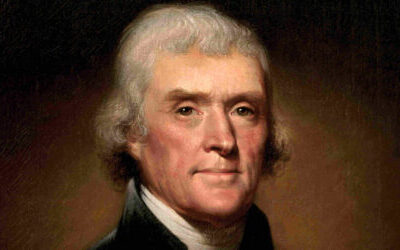
However, this particular author’s point was exactly the opposite. He did not refer to himself as “evangelical” because he did not hold to the view that Christians needed to evangelize. He believed there were many ways to the Father. In supporting his view, many quotes were provided including one from Thomas Jefferson who said, “it does me no injury for my neighbor to say there are twenty gods, or no god. It neither picks my pocket nor breaks my leg.” (2)
I’ll address the “no injury” of Jefferson’s statement momentarily but, first, I have to note that this statement, while quoted accurately, is completely out of context. I don’t believe that we should think that our founding fathers, or Thomas Jefferson specifically, were anti-Christian or anti-evangelism. While we might differ in our opinions about Jefferson’s, or any of America’s founding fathers’, personal beliefs and faith we can, I believe, say with confidence that this statement was not anti-Christian. No way. No how. Nor was this statement opposed to the spreading of the gospel.
What did Jefferson mean when he said, “It does me no injury for my neighbor to say there are twenty gods, or no god?” He was speaking of the nature of a government’s responsibility to its citizenry. Jefferson’s view was that a government’s responsibility was to protect its citizens. It is not the government’s role to establish a religion or support one particular religious system because that would inhibit the freedoms that the government was established to protect. Jefferson’s statement was not intended to be anti-religion, anti-Christian, or anti-evangelism.
While Jefferson believed the government should have no role in religion or evangelism, Jesus commanded that those who follow Him evangelize. While many gods or religions cause “no injury” that the government should have a role in protecting, we, as followers of Jesus, do have a responsibility to prevent injury to the lost. Indeed, an eternity separated from God is an injury in the deepest sense. And that most grievous of injuries is avoidable through Jesus. He was very clear when He said “I am the way the truth and the life. No one comes to the Father except through me.” (John 14:6)
As an American, I stand wholeheartedly with Jefferson’s idea that the government should have no involvement in religion except to protect its free pursuit. At the same time, as a Christian, I must be fully committed to sharing the good news and evangelizing about Jesus. Of course, we don’t need to be, and shouldn’t be, intolerant or judgmental as we share. We always share “with gentleness and respect.” (1 Peter 3:15)
We have great freedom to share about Jesus in the United States. Let us thank God for that freedom and continue to obey Him by sharing when and where we have opportunity.
(1) https://www.nae.org/what-is-
(2) Jefferson, Thomas. Notes on the State of Virginia. Edited by William Peden. Chapel Hill: University of North Carolina Press for the Institute of Early American History and Culture, Williamsburg, Virginia, 1954.

David Foucar loves teaching God’s Word and has led classes, Bible studies, and groups of all ages. He has preached in churches and spoken at retreats and camps nationwide. His first book, What Do I Say When Asked About Jesus?, offers practical tools to help everyday Christians share their faith with confidence. Dave and his wife, Debbie, have been married 36 years and are blessed with three daughters, two sons-in-law, and two granddaughters. Follow him on Substack.
Image by Wallpaper Safati
I love this post and how you clarified your perspective.