
Have you ever felt like God called you to something, and you started doing it, only to find that everything got a lot harder once you started obeying him? It made you ask, “God, what’s going on? It feels like things are going the opposite of how I expected them to go! I expected you to bless me when I started to obey you, and it almost feels like you’re resisting me!”
I’m thinking of a guy in his 40s at my church who, a few years ago, felt like God was calling him to resign his high-paying corporate job and move overseas with one of our church planting teams. Right after he did that, his teenage son got diagnosed with a genetic disorder that was going to require really expensive medical care. I remember his response, because it’s the same one I would have: “Really, God? Now? Right after I resigned my comfortable corporate job?”
I’m also thinking of a pastor friend who started leading his church into some bold new phases of ministry, and then in the space of one week, got diagnosed with an autoimmune disease, some irregularities in his eyes, and a neuropathy in his brain stem. Within one week. All of these were serious, but the neuropathy issue was causing this stabbing pain to shoot through his head whenever his blood pressure rose.
The doctor told him, “Look, for the next several months, I need you to cut out any and all stress from your life.” To which my friend was like, “Uhhh, our church just took on these faith commitments, and stress is part of the package. Plus, I have a son just entering middle school and going through puberty. Saying ‘Don’t get stressed’ is like telling someone who’s about to jump in the ocean ‘not to get wet.’” But it left this pastor asking, “God, seriously? Why now?”
Have you ever felt like that? You started to obey God. But instead of things getting easier, instead of the path opening up before you, it gets much, much harder. It makes me think of Moses, who faithfully listened to God—only to have Pharaoh make life worse for the Israelites after Moses arrives. The people lashed out at Moses, and I don’t blame them. Why would God start his rescue mission by making the situation worse?
Here’s why: In order for Moses and Aaron to really understand that God is the only Savior, he had to let them fail a few times. When it was all said and done, no one would be in doubt who pulled this off. God didn’t want Moses or Aaron or any other Israelite taking any of the glory that belongs to him. So he orchestrated the entire deliverance to prevent anyone from talking about how awesome they were, how brave they were, or how amazing their speeches were. Moses and Aaron were just some ordinary dudes. God was the Savior.
Here’s how the Apostle Paul said it in 2 Corinthians:
We do not want you to be uninformed, brothers and sisters, about the troubles we experienced in the province of Asia. We were under great pressure, far beyond our ability to endure, so that we despaired of life itself. Indeed, we felt we had received the sentence of death. But this happened that we might not rely on ourselves but on God, who raises the dead. He has delivered us from such a deadly peril, and he will deliver us again. On him we have set our hope that he will continue to deliver us. (2 Corinthians 1:8–10 NIV)
Look at those phrases! It was only when we experienced great pressure, far beyond our ability to endure, to the point that we despaired of life itself—like we had “received the sentence of death”—that we learned to rely on a God who raises the dead. And only then could we testify to a God who raises the dead. Before we could demonstrate that the power to rescue and heal and save was in God alone, we had to demonstrate that that power was not in us. No flesh will glory in his presence. Not mine. Not yours. Not Billy Graham’s. Nobody’s.
God will let J.D. Greear fail so that your hope won’t be in me, but in God. Do I like that? No. But is it God’s pattern? Absolutely. Because God knows how much we want to worship our heroes, he makes sure that every one of them fails. Moses will let you down, and J.D. Greear will let you down, and your dad and your coach and your spouse and your friends will all let you down.
But God never will. And if we place our hope in him, we won’t be able—because in him, even death isn’t final.
J.D. Greear is the pastor of The Summit Church, in Raleigh-Durham, North Carolina. He leads the Summit in a bold vision to plant one thousand new churches by the year 2050. Pastor J.D. completed his Ph.D. in Theology at Southeastern Baptist Theological Seminary. He has served as a member of the Board of Directors of Chick-fil-A since January 2022 and recently served as the 62nd president of the Southern Baptist Convention. Pastor J.D. and his wife Veronica are raising four awesome kids: Kharis, Alethia, Ryah, and Adon.This article has been republished with permission from the J.D. Greear website and is under copyright law. It may not be republished without express written consent by J.D. Greear Ministries Team. J.D. Greear is the author of 27 Books including his newest book, Everyday Revolutionary: How to Trancend the Culture War and Transform the World.
Image by ChatGPT
Books by J.D. Greear
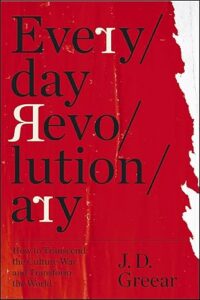 In Everyday Revolutionary, pastor J.D. Greear calls us to reimagine our Christian witness in today’s world. Written for those of us who feel like outsiders in this new era, Everyday Revolutionary draws on the story of Daniel to help us “live sent” right where we are. This Christian guide to “living quietly but testifying loudly”
Well stated!! It implies that disappointment in people is a result of looking for perfection, stability, and love in “mortal” or material relationships rather than in divine Spirit, God. It is a wake-up call to stop relying on broken human affection and instead depend entirely on God.
Your friend – His servant,
Isaac Otieno